8 March 2012

We rescue sad Ceria

Silje Robertson introduces a second new arrival to our centre this week...

On 7 March our team was called out on another rescue operation. Only 20 minutes drive from the centre a young female orangutan was being held captive in the town of Mulia baru, Ketapang.

The owner claimed to have found her hurt on the ground in a palm oil plantation a week earlier, but changed his story a few times during the time we were with him, so as usual there is no way of knowing the truth about the animal’s background.

She was kept in a cage outside their house together with a large number of hens. She had a chain around her neck, confining her movements inside the already small cage. Although the skin in the area where the chain was is not damaged, the lack of hair and the skin colour indicates that she had been wearing the chain longer than the seven days claimed by the owner.

Her name is Ceria which in Indonesian means happy or carefree, and it is a tragic irony. She is clearly depressed, nervous, underweight and suffering from malnourishment.

Fortunately she is eating and drinking well with us and seems to have no other medical problems. Her estimated age is 3-4 years old; she has long healthy hair and looks so much like Butan that they could be sisters. She will be monitored closely during her quarantine period, even more so because of the possible health risks associated with living so closely with poultry.

6 March 2012

The Great Projects volunteers do great work to help the orangutans

Volunteer vet Jesus Mayoral from Spain meets some of the volunteers working hard to help us build our much needed permanent rescue and rehabilitation centre...

Priority 1: Building a new enclosure for our babies
This last month we have been so lucky to have a group of volunteers from The Great Projects team at the centre. They have been sweating and working hard almost every day, either building fences or cementing at the new centre or helping the staff make enrichment for the orangutans. They also constructed a wonderful new play platform at the baby school.

Not only were they fully committed and totally devoted to orangutans, they were really charming people with plenty of experience and knowledge to share with all of us. These are statements from some of them, I hope YOU will be inspired by what they say and want to help us build the new centre too!

Construction of the security tower is under way
Lisa and Noel from the UK:
“Being involved in the early stages of the construction of IAR’s new rehabilitation centre, we felt we were making a truly valuable and very visible contribution to the ongoing rehabilitation work that IAR carries out. The staff is realistic, open and very candid in their approach to rehabilitation, and this, alongside their transparency in where your financial contribution goes, and their obvious embracement and gratitude for the volunteer programme they have, means that we would recommend this programme to you unreservedly over other options in volunteer work with orangutans.

This could be YOU!
“Even though some of the work we have done has been physically demanding and the environment challenging, it’s been a highly rewarding, hugely enjoyable and very memorable experience.”

Fiona from Switzerland:
“I guess, in the end it was this combination that made me loving this project so much: on the one hand, you felt really helpful (even if you didn't bring in some special building skills) and being involved in an important process. And on the other hand, the project also consisted of this element of education - we had the possibility to visit Semengoh and Matang on our first day and - even more important - I learned so much on the days we spent at the IAR Transit Centre and it was just great to get in touch with people who have such a big knowledge and such a big experience in what concerns the orangutan conservation. Also, the whole team never got tired of answering all our questions!”

To find out how you too could volunteer and help orangutans, visit The Great Projects.

5 March 2012

Introducing Desi

Vet Silje Robertson introduces another new arrival to our emergency rescue centre in Ketapang…

Last week our team ventured out on a new rescue operation. Our investigator had discovered an orangutan being held captive in the town of Pemangkat, Melano. Together with the forestry department and our collaborating organisation Yayasan Gunung Palung we set out last Friday 2 March.

The young female orangutan, called Desi, had been with the family for over two years, living outside their house in a steel cage of about 2 square metres. She was very dirty and clearly distressed when our team arrived, but otherwise in good condition. The family claimed at the time to have bought her from a palm oil plantation worker. Desi had been fed whatever her owners had available: at times fruit but more often rice, chicken and other human food items.

She is quite habituated to humans and in our quarantine cage she is still nervous and shy and clearly needs time to adjust to her new situation. Desi is about 4-5 years old. Fortunately she seems in good health, has long beautiful hair and is eating with a good appetite. We will give her the time she needs to feel safe with us and, once she finishes her quarantine period, we will introduce her to her new friends and environment.

28 February 2012

Noel joins us, Ongky and Puyol move on to ‘big school’ and Butan finally meets the other babies

Vet Silje Robertson updates us on how the babies are getting on at our emergency rescue centre in Ketapang
 
Noel
In this month we welcomed Noel as our newest orangutan. He was in good physical shape when he came to us but it soon became clear that he was mentally traumatized by everything that had happened to him. We will never know for certain what his story is, but there are many indicators that he has not been with humans for very long. For example when we brought him leaves he immediately began padding them down as if wanting to make a nest, skills he has most probably learned from his mother. Noel is still anxious and does not like being left alone – even just for a second, but he is becoming more and more independent and once he finishes his quarantine period he can start socializing with the other orangutans.

Ongky and Puyol
A few weeks ago Ongky and Puyol were moved from the baby school play area to the transit play area. The reason for this was that the two boys were becoming rougher in their play and it was clear that they needed more space and challenges. In the back transit area we have many platforms, larger areas and more trees than in the baby school area. After an initial health check with good results the two were moved. The first period they clung to each other and to the baby sitter more than they played, obviously a bit overwhelmed by the new surroundings and playmates. After some time though they both became braver and now they are well adapted and seemingly enjoying all the new space and playmates.

Butan and Rahayo
It was a very happy month for all of us as Butan, the female 4 year old orangutan who was rescued in November last year, was finally introduced to the other babies in the baby school play area. As you may remember, Butan suffered from a malaria infection and severe malnourishment when she first arrived at the centre, and was critically ill for many weeks. Still she has not reached the appropriate weight for her age but in the last weeks she has been getting stronger (and cheekier) and has been healthy with a good appetite. She prefers to play mostly on her own off the ground, but will join in and battle the others when there is enrichment. The other babies leave her for the most part in peace, with the exception of Rahayo who constantly tries to get her in on the play. The two malaria sisters! It has been a very long process and it is extremely rewarding to see her climbing the platforms and trees in the play ground.

In the case of Ujil, the young male we sadly were not able to confiscate last month, there is still no concrete news. Our team is constantly cooperating with other organizations, the police and the forestry department in order to find a solution as soon as possible.

14 February 2012

Enter: Noel

Vet Silje Robertson introduces the latest newest arrival to our emergency rescue centre…
 
Yesterday a man arrived at the centre and explained that about a month ago he had found a baby orangutan at the oil plantation where he works. He then offered to sell the animal to IAR, which our field manager, Argitoe made clear to him that we would not do. We got the location from the man, and early today our team set out to confiscate the animal.

As they arrived in Kepayan, Siduk they found a very young orangutan locked in a wooden cage. The man from yesterday was nowhere to be seen, but his wife and son willingly handed the small male to our paramedic, Rica. The orangutan is a small male, about 10-12 months of age and apparently in good health other than being slightly underweight for his age. We will monitor him closely over the coming weeks, and keep you posted on the progress of our newest member, Noel.

See more of Noel:
Noel: Facebook album
Video of Noel eating Rambai fruit

27 January 2012

Two of our female macaques make great mums!

An update from our primate centre in Ciapus, Java from volunteer Chris Wiggs.

On 3rd January, James, an infant male pig-tailed macaque, was brought in to our rescue centre in Ciapus by an expatriate European family living in Indonesia, who had kept him as a pet for 2.5 months. James is an extremely active young macaque, and our mandatory tests on arrival confirmed that he was healthy.

Baby Macaque RescueWhat to do with very young primates is always a challenge. Like human infants, they need a lot of affection, love and care, but if that is provided by IAR staff, there is a danger that they will become too dependent on humans, and jeopardise their chances of rehabilitation and eventual release, the ultimate goal of our project. Luckily, not long after we confirmed he was healthy and unable to pass any disease to other macaques, we were able to place him in a cage with Nonong, an independent adult female, who we hoped would adopt James and raise him herself. IAR staff were all tentative as we introduced them to each other, but as it turned out, there was nothing to be concerned about. Nonong and James have developed a strong bond, and Nonong is an extremely attentive mother, happy to share her food with James and indulgent of his rather boisterous character.

Macaque Rescue IndonesiaJames was the second baby macaque that had been brought to our centre in the last few months. On 25th November, Dora, a female long-tailed macaque, was bought in by staff from the Jakarta Animal Aid Network. Dora was quite thin and extremely anxious when she first arrived, but in otherwise good health. After spending sometime in quarantine, building up her strength and getting accustomed to her new surroundings, it was decided that we would introduce her to Joy, an adult long-tailed female. Like James and Nonong, the introduction went well, and Dora and Joy now share a large enclosure together, and it’s lovely to see them play together, using the enrichment we provide and sharing food.

It’s heartening to see how well Joy and Nonong have taken to motherhood, and how well Dora and James have adapted, and we hope it bodes well for their future in the wild. However, while these two may have found a foster mother and now await their release into the wild, we can’t ignore that many other macaques are kept as pets - often caught when they are very young. IAR continues to educate and create awareness about macaques used as pets and strongly discourages people from doing this NO matter how cute they are!

24 January 2012

Three macaques get their first taste of freedom

News of our latest macaque rescues from Chris Wiggs, volunteer at our primate centre in Ciapus, Java.

The IAR team setting Koja free from the chain that binded him for many yearsOur macaque and slow loris rescue centre in Ciapus was recently contacted by a member of the public, concerned about a long-tailed macaque she had seen chained up in a residential street in the Indonesian capital, Jakarta. Long-tailed macaques are a common household pet throughout Indonesia, and it isn’t unusual to see them kept in this way, particularly when they reach adulthood.

Further discussions with this woman revealed that she was herself the owner of two long-tailed macaques. After our vets explained about our centre and the ethical issues and challenges of keeping primates in captivity, she agreed to hand them over to us. So last week the IAR team headed to Jakarta to rescue three macaques!

Koja spent many years living like this.The first macaque was an adult male that was being kept outside someone’s house, and was attached to a wooden bench by a chain around his waist. Although the owner insisted he often took the macaque for walks, the macaque looked agitated and was continually biting himself. The area was busy, and directly opposite a very noisy school, so it isn’t difficult to imagine how frightened he must have been. In these situations, IAR vets usually use a blow dart to anaesthetise macaques, but as a large number of local people, including children, had gathered round to watch, it was decided to try and sedate him by hand. The IAR vets assessed the situation and felt it was safe to do it by hand while using a net for protection. How local people interpret our actions is incredibly important to us, and we were worried how using a blow dart would look, particularly to school children! Once the macaque had been anaesthetised, he was transferred in to an IAR transport cage, and our vet Intan gave a presentation to the local residents about our project, why we were taking the macaque and our veterinary procedures. Leaflets were also handed out. The fact that a member of the public had alerted us to this macaque in the first place is a positive sign, and we hope our outreach activities continue these developments!
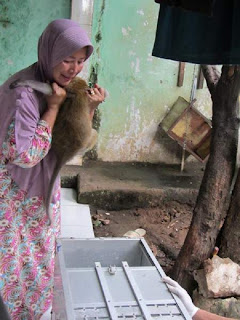
The owner who called us and was willing to give up her macaque despite being very sad. Here she is seen helping put her macaque into the transport cage.We then went to rescue the two macaques kept as pets. One of these macaques, a young female, was chained to a tree, while the other, a slightly older female, was kept in a cage. Although the conditions were completely inappropriate for macaques, in a busy residential area, just off a main road, and the macaque in the cage had obviously been plucking the hairs out of her legs, the owner clearly loved the animals, and she had a good relationship with them. Although she was upset to give them up, they will have a far better life at our centre, where they will be introduced to other macaques, begin the rehabilitation process and be assessed for possible future release back in to the wild.

All three macaques are currently undergoing quarantine, and will be tested for any diseases in the coming days.