11 September 2012

Update on new arrivals Rickina, Roy and Johnny

By vet Silje Robertsen
 
Last Saturday we received two new animals that had been confiscated by the forestry department in Pontianak, the capital of West Kalimantan. We do not have much information about their captive living conditions, but they were not confiscated from the same owner though both are in good physical health.

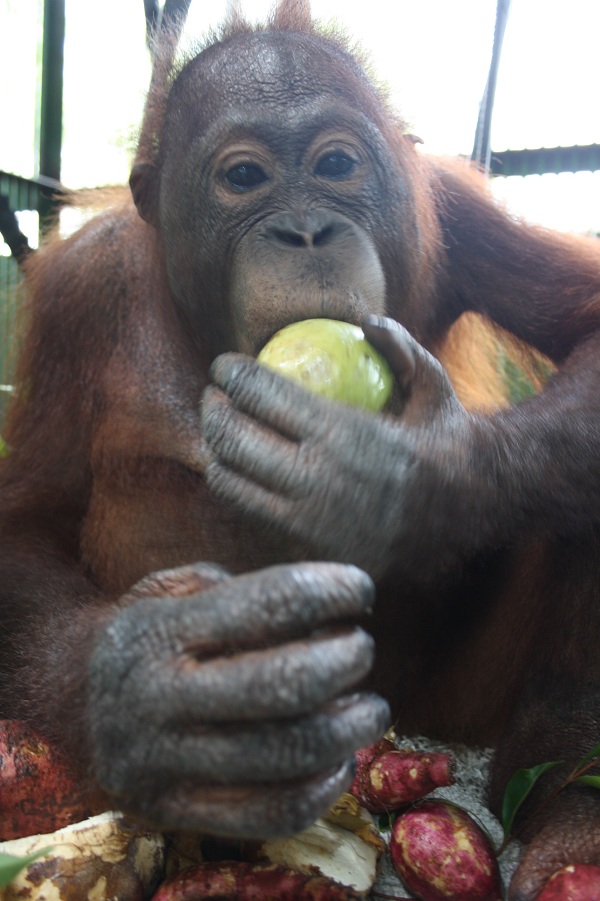
Roy
Roy is a young male of about 3-4 years and unfortunately seems very habituated to humans indicating that he probably was taken from his mother at a very young age and has been living in captivity ever since.

Johnny is a few years older than Roy and a bit “rough around the edges”, but still very habituated to humans indicating the same early life fate as Roy. They are both placed in our quarantine cages and their group placement will be decided after the health screening and the quarantine period is successfully completed.

Johnny
Rickina, who was rescued a few weeks back and was suffering from a skin wound on the head, is showing good improvement. The wound is almost completely healed and she is a very active and independent young orangutan.

22 August 2012

Updates on all the orangutan antics in Ketapang


Baby orangutan Noel
By vet Silje Robertsen

At our orangutan rescue centre in Ketapang some of our younger orangutans have been introduced to new areas. Marsela, the young female who was rescued from a palm oil plantation in February this year was moved from the baby school to the larger play area for the juveniles and seems to be thoroughly enjoying the new space here.  Monti has also been moved to the larger play area and after an initial period of scepticism she is now playing enthusiastically and is settling in well with the “big guys”. 

Ujil was initially placed with the older babies in the back transit area, where he seemed to be settling in well. After some weeks though, it became clear that he was not coping too well in the new environment and he was showing signs of depression. The past month he has been together with the younger babies in the baby school area and here he seems to be more content. He is a gentle character, but knows how to defend himself in the not so seldom play fights with Jack or Bandut. He also keeps the baby sitters busy as he is continually looking for weak spots in our fencing and breaks out. 

Gunung and Noel are enjoying the status as the babies in the group. Especially Lady is thriving in the role of surrogate mother and loves pulling Gunung’s long hair. Also Rahayu and Oscarina will join in on the play: even when Noel and Gunung might be heading off in another direction they will firmly, but kindly, convince them to stay and play with them.

Pelangsi is showing a steady improvement as his wounds from the amputation operation have healed. It will surely be a long process for him to learn how to cope with his new disability, but he has already developed a technique for gathering leafs with his healthy arm and his mouth.

Rescued orangutan Jacky
On Saturday 18 August a young male orangutan was surrendered to our centre. He is called Jacky and is about one and a half years old.  He has probably been kept as a pet for most of his life as he is very attached to humans, but he has no signs of physical illness.  For now he is in our baby quarantine area awaiting the results of his health screening and if all is clear after the quarantine period he can join the other babies in the play area.

3 August 2012

Reducing stress in captive slow lorises

By Andy Gray 

Slow loris researcher Andy Gray
I am currently a volunteer researcher at IAR’s Ciapus Primate Centre studying to get my Master’s degree from Oxford Brookes University. In my 3 months here, I have been conducting a captive study to examine which types of enrichment might reduce stress for the slow lorises living here. In particular, I have used tree gums, as gouging large holes in trees for gum has been reported often in the wild. Because many of the lorises at the centre have their teeth brutally clipped or pulled in the illegal trade, gouging these holes is quite difficult for them in captivity. My goal was to provide a successful way for the lorises to eat tree gums while still performing some “gouging” behaviours through soft materials, like banana leaves. I also wanted this to be challenging and entertaining enrichment for the lorises with teeth as well.
It has been incredibly rewarding to watch the lorises enjoy the enrichment that the keepers, vets, and I designed. We have given them pine cones with mashed banana, branches with gum inside holes wrapped with banana leaf, and frozen gum and kalliandra flowers inside large bundles of grass (I suspect they liked this last one the most!). I have been very busy collecting as much data as I can for this study. The keepers joke that I have become a kukang (loris) because I collect data until 5am. It is incredible to be alone in the nighttime watching the lorises. I can’t say I’ve ever seen anything like it before. 
Erwin eating gum enrichment
Beyond my enrichment study, I have also conducted an experiment regarding boldness and shyness of the lorises. I have focused on lorises who are candidates for release, and have used novel objects to determine how willing they are to approach and explore new things. I hope that this will be beneficial for the centre when judging which lorises are the best candidates for release, because studies with other species have shown that animals survive better post-release if they are either bold or shy (depending on the species). No one has studied this before in lorises, so it is unknown whether or not they are more likely to survive if they are bold or shy. I am very excited for the long-term research possibilities for the centre, even after I leave. 
This project has been incredibly rewarding. It feels good to be contributing to both the captive care and the reintroduction project here at IAR Indonesia. However, the root of the problem is the illegal trade. In the future, I hope I can also be involved in efforts to combat this, as it is so important for the survival of the species and individual welfare. Please follow IAR Indonesia’s fantastic law enforcement work, and keep spreading the word about stopping the illegal wildlife trade!

9 July 2012

Education and Mitigation of Macaque Conflict Programme


By Indri Hapsari, Education Coordinator

June 27th 2012 education coordinator Indri Hapsari and Mitigation of Macaque Conflict Programme coordinator Ayut Enggeliah Entoh went to the BDN elementary  school in Jakarta to give presentations about animal welfare and the facts about monkeys. Education was given in two parts, first part was 1st – 3rd grades and the second one was 4th – 6th grades. The students were pretty enthusiastic but the 1st -3rd grades seem to be particularly interested. They paid a lot of attention to what the team explained and asked the most questions.

The awareness team provided basic knowledge and facts about monkeys, especially the long- and pig-tailed macaques. They also spoke with the students about animal welfare and explained that we should not keep monkeys or other wildlife as pets.

Most students think that monkeys eat bananas and peanuts and that it would be alright to feed monkeys because it  means that they  care for them.

The public perception  of  monkeys is completely mistaken and  we hope by conducting  awareness activities many people will improve their understanding of these animals. And as a result they will not look at Topeng monyet or feed wild monkeys. Hopefully too they will laugh less when they see a picture of a monkey or ape.

Topeng monyet is a traditional entertainment using monkeys doing tricks like riding a motorcycle, shopping and dancing. The problem is how the monkey is made to do these things. The trainer tortures the monkey by beating  it or not giving it food if it isn’t obedient. Even, to make them walk on their hind legs only, trainers will tie a rope round their necks and pull the rope up so they are forced to stand upright. Not watching or giving money can help lessen the Topeng monyet activity.

Feeding wild monkeys can contribute to their bad habits. Because they can get food easily, they will not try to look for food again in the wild. They will just beg from humans or even steal it.

Lastly, for some reason if people are shown a picture of a monkey they laugh. We’re not sure about the real reason but maybe because monkeys are creatures that people used as objects to tease, someone or some myth and legends put monkeys as the villains in the story. These things create a negative perception in people’s minds.

To change people’s attitudes  is not easy, especially in an elite community where people don’t want to be bothered. One thing we can do is raise awareness among children, and hopefully they will pass the message on to their parents.

13 June 2012

Putting our primates back into the wild

Vet Sharmini Julita Paramasivam reports on another success story from our Primate Rescue Centre...

Yayasan IAR Indonesia (YIARI) functions to rescue, rehabilitate and release to the wild two of the most traded primate species in Indonesian pet markets which are slow lorises and macaques. Rehabilitation means that we work hard to remind these animals that they are wild, since usually most spend their lives as pets, away from their own species, consuming human food and performing behaviour that is not normal in the wild. Rehabilitation involves a specific diet and feeding pattern that will make them ‘work’ for their food, something that they must learn in order to survive in the wild. For macaques, socialization with other individuals when they are ready is the next step to form social groups that they will live with in the wild. Once they form a solid group and are showing wild behaviours, the next step is to release them into the wild.

On the 29 May 2012, a release operation involving 6 pig-tailed macaques and 2 slow lorises was carried out on the island of Lampung in Sumatra. The macaques consisted of 5 individuals in a group led by the dominant male named Rambo for his size and soft heart and an individual dominant male called Bendot. It was a good feeling bringing these animals, indigenous to Sumatra, back to where they belong, seeing that they were brought to the Javan island illegally. After a long 24 hour journey from our centre in Ciapus, Java, all the individuals who were in good health although restless after the long journey, were placed in a habituation cage which is a cage made in the forest to allow acclimatization to the wild conditions. 

After 2 days of habituation, it was time for them to have their first taste of freedom. Rambo’s group, consisting of one adult female (Nonong), 2 juvenile females (Julia and Virgo) and a young male (James), were released back into the wild when we cut the net and set them free. It was fantastic to see all the young ones following their leader. When James couldn’t find his way out of the cage and cried for help, the group rushed to his aid and made sure that no member was left behind. Next it was Bendot, who we were afraid might be aggressive, but instead he demonstrated how much the animals appreciate our work when he stepped out of the cage and walked away in complete peace. The team will continue monitoring the macaques to ensure they are doing well in the wild.

The two Sumatran lorises were placed in our newly designed open top habituation cage that provides a proper natural environment exposure before returning to the wild. They were quick to settle in and started exploring the cage and environment very quickly. Both lorises are fitted with a radiocollar that allows for monitoring after being released. This is part of YIARI’s post-release loris monitoring programme - the first ever to be done in Indonesia to make sure that individuals survive and to understand the way lorises live in the wild to help improve the rehabilitation process at the centre. After a few weeks of habituation time in the cage, they will be released and a team will follow them every night to make sure they are well.

All in all, it was a great success with all the released animals looking healthy and active in the wild. Importance is placed on releasing these animals as it brings great benefits such as increasing the long term conservation prospects of these species; it also acts as a good awareness strategy to teach the public not to keep wild animals as pets and promotes good animal welfare by allowing the animal to live in its natural environment. Ironically, buying wild animals out of pity to ‘save’ them from the horrible life in the markets is NOT a solution. This is because one empty cage means a replacement being caught from the wild. YIARI works hard to spread the message that wild animals belong in the wild and should not be kept as pets, no matter what the circumstances.

11 May 2012

Education and awareness-raising activities in Indonesia

Volunteer Tine Rattel reports...

Information stand at a local animal market
International Animal Rescue recognises the importance of public education as an integral part of conservation outreach, with the ultimate aim of changing attitudes to conservation, resulting in pro-conservation behaviour.

Part of our education and awareness-raising involves analysing local people’s attitudes, knowledge and values concerning animal welfare and conservation. Our efforts focus on expanding the community’s capacity to improve environmental quality by educating both children and adults. The fundamental aim of our education efforts is that pro-conservation behaviour will be adopted within those communities currently exploiting natural resources, in the form of a reduction of resource extraction to sustainable levels and the elimination of illegal activities such as hunting of endangered wildlife. The central message we disseminate is that people need to protect their environment to ensure that successive generations have a chance for a good future, with the same ecosystem services they rely on. We encourage people of every age within and outside their community to work collectively by addressing their common interests.

The public sign a pledge to not buy a slow loris
Our long-term aim is to balance the inevitable conflict between short-term needs of local people and long-term benefits that conservation programmes can generate. If local people and the government recognise that preserving the environment provides socio-economic benefits, rainforests will survive as functional ecosystems, and the future of their inhabitants will be secured.

Our Education and Awareness Coordinator, Indri Hapsari, is currently focusing on community education aimed at children from ages of 10 up to 18 by giving presentations about biodiversity conservation and animal welfare at schools and our Slow Loris Awareness Campaign Coordinator, Indah Winarti is carrying out awareness activities by having information stands at local markets in the cities and at universities, as well as giving workshops in villages in habitat areas. Both are additionally raising awareness by providing important information and answering questions about the wildlife trade and conservation issues using social media like Facebook and Twitter.

Raising the profile of the plight of the slow loris
Engaging with young people to facilitate their personal, social and educational development and encourage them to become an active member of our awareness activities is a vital part of our work. We believe that educating the future generation at a young age to appreciate and conserve wild species will increase the effectiveness of our programme.

Another important part of our Slow Loris Awareness Campaign is to conduct seminars for governmental authorities to increase the awareness for this low-profile species.

Posters at a local market
There are three species of slow loris in Indonesia and all are threatened with extinction. The Javan slow loris has even been included in the “IUCN Red List of 25 Most Endangered Primates of the World”. Whilst habitat loss was once deemed the major threat to the survival of the slow loris, it has recently been suggested that trade, both for the pet market and traditional medicine, is having the greater impact on population numbers. Despite the national and international laws prohibiting the trade in slow lorises, they are sold openly in animal markets throughout Indonesia. The following-through of law enforcement is essential if current legal protection for Indonesian wildlife is to be effective.

See more pictures of our awareness building activities
Join the Facebook group

3 May 2012

In spite of her traumatic past, Peni is a happy, healthy, playful girl

Vet Jesus Mayoral provides an encouraging update on Peni, who was rescued from a horrific situation by our team in 2010...

Peni with her mother before her rescue.
Photo: Feri Latief
Peni was brought to IAR’s Centre in Ketapang at the end of October 2010. Despite starvation and the horrendous experience she had been through, she was in reasonably good physical condition when she arrived. IAR’s vets performed every routine test necessary to have a better picture of her physical condition. That was the first step to rehabilitate her, the easy one.

Peni now! Photo: Julie O'Neill
For Peni, and also for all the people involved in her rehabilitation, the most difficult task was to overcome the psycological trauma, but thanks to her strong nature and the company of fellow females Susi, Prima and Helen she did really well from the beginning.

During this year and a half she has been very healthy (just a minor flu last January) and playful. She likes to vocalise and show her emotions in this way. Recently she lost her upper milk incisors, which is the normal process at her age. Dentition is the clue to know the age of babies and children but it is not 100% accurate. Anyway, the loss of these teeth seems to confirm our initial guess. By now she must be around 6 years old, a healthy, strong girl, full of life, who hopefully will be ready before too long to go back to the forest!