18 April 2013

International Animal Rescue's Primate Diaries: Dramatic rescues


Four more are safe...

...For now.

This mother tried to hide up the only remaining tree. The
team searched desperately for her baby but without success 
International Animal Rescue and the local foresty department (BKSDA) in Ketapang received reports of several orangutans trapped in the fragmented areas of forest near a palm oil plantation in Tanah Merah, which is about 3 hours by car from the new rescue and rehabilitation centre in Sungai Awan. With their forest home destroyed, the animals scattered and began to wander the area in search of food and a new place to live. The palm oil company asked for help to move the orangutans, who had become a nuisance because they were eating the young fruits from the palm oil trees.  A collection of forestry department workers, assisted by individuals from IAR, had already begun conducting environmental surveys in the bordering forest to find an appropriate place to relocate the orangutans. They found evidence that the orangutans were eating bark and stems, as there was little fruit and few leaves available.

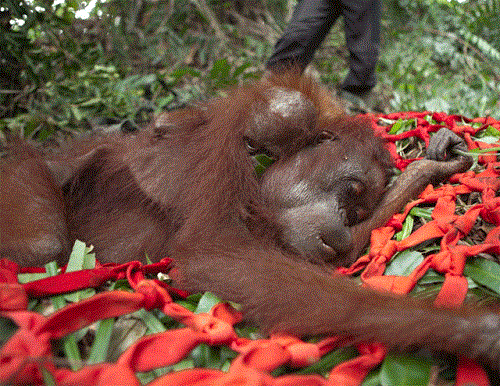
Our team worked fast on a general health check while
the animals were sedated
In the third week of March, the rest of the IAR/BKSDA team arrived to see the desolate and depressing landscape, which is the product of the destruction of the forest within the borders of the plantation. Workers from the palm oil company helped the team to locate the individuals in need of rescue. The first was an adult female who had been spotted with a baby. When the rescue team arrived, the baby could not be found, and it is suspected that it was taken to be kept as a pet, sold to the highest bidder, or worse. The mother, who was still lactating, scrambled high into a single bare tree, so there was no good way to sedate her at that time. The group waited for her to come down and followed her across the apocalyptic terrain before she was safely captured.  

This orangutan and her baby were starving to death due to
deforestation. 
A second female was caught while traveling along the ground, and she was found to be pregnant. It was already dark when she recovered from the sedative, but she had to be released that night as she was very stressed in the transport cage.

The last two to be moved came together as a mother-baby pair, which complicated the darting process because the baby was clinging tightly to her mother’s back the entire time.  Both were very thin, but the mother handled the drugs well, and the baby silently watched while still clinging on.

The baby clung tightly to his mother throughout the entire
process
Heavy rain fell on the team and the animals during the transfer, but everyone made it safely to the forest at the border of the plantation. The future remains questionable for all in the forest, and saving the land from further industrial use is of utmost importance for the orangutans.

3 April 2013

International Animal Rescue: Good news from the slow loris team


Good news from the Salak Mountain slow loris monitoring programme

By vet Wendi Prameswari

Arjuna has his tracking collar changed
On 30 March, Arjuna, a released male Javan slow loris, was caught by the monitoring team because his collar was due to be changed. Arjuna had survived seven months in the forests of Mount Salak, displaying extensive ranging and active behaviours. The medical team went too in order to give him a health check whilst the collar was being replaced. Arjuna was found to be in good condition with a body weight of 840 grams. His body weight had dropped slightly since he was first released, but this is always expected owing to the increase in foraging and travelling requirements once back in the wild. A new collar was fitted and monitoring will now continue for another six months until he has successfully survived across the two seasons (wet and dry).

Arjuna poses for the camera beautifully before his
release back into his jungle home
There are close to 100 slow lorises at our rescue centre in Ciapus, Java – all victims of the illegal wildlife trade which in recent years has been fuelled by YouTube videos depicting them as cute, cuddly pets. Eighty per cent of the rescued lorises have had their teeth cut out by the pet traders before they are sold – a cruel and painful practice which frequently leads to infection, septicaemia and death.


Our team in Ciapus continues to investigate whether slow lorises that have lost their teeth can still survive and fend for themselves in the wild.

27 March 2013

International Animal Rescue: Back to back rescues!


By vet Christine Nelson

Amin has finally arrived! It took nearly 24 hours of travel over a great distance and bumpy roads, but he has found a new home in Sungai Awan. The rescue team took the long journey through some areas of destroyed forest to the staff quarters of a mining company where Amin was kept as a pet for 2 years.  He was purchased by the company’s owner and mostly spent his time chained around the hips with a tree house for shelter.  Once he got a little older and a bit more destructive, he was moved to a platform in a tree, and the chain was put around his neck. 
Amin is gently lifted out of the
elevated platform he had been chained to

Amin is about 5 years old now and seems to be in good health despite his previous diet of rice and fried chicken with some fruits.  His behaviour has been a little unpredictable, but he is calming down and settling in fairly well. He has gone through some initial testing, but he will have to be re-evaluated, especially because of his long period of contact with humans.  

Soon after plans were made to pick up Amin, International Animal Rescue was made aware of another baby in need of rescue. It was hoped that this next new addition could be picked up the same day, but the team would have arrived too late in the night, so the operation had to be postponed. A couple of days later, a team was able to return and found a male orangutan named Onyo, aged between a year to 18 months old. This little one had lived with a man for about 7 months, and had been drinking milk and eating rice. The man stated that he likes to keep animals and that he found Onyo at the bottom of a tree after seeing the mother run away. This is highly unlikely, females orangutans do not simply leave their babies, so it is assumed that his mother met with a more unfortunate end. 
Little Onyo is bold and brave out in
the safety of the forest enclosure

Onyo is quite agreeable and has allowed us to do some health screening without sedation. He has a couple of dry skin lesions, but is in good health otherwise.  Onyo is having fun climbing in the trees and shaking the branches, as well as trying lots of new foods.  He seems to have no problem being in front of the camera, and he likes to offer many poses.  

Watch out for further updates on the progress of Amin and Onyo, as we will have more stories to tell after their quarantine is fulfilled and they can be introduced to the rest of the orangutans.

13 March 2013

International Animal Rescue: Update from the orangutan centre


By vet Christine Nelson

Roy shows off his his multi-tasking skills


Times are busy for the orangutans in Sungai Awan, as well as for the humans looking after them.  We are constantly tweaking the routine to better accomodate the animals and give them the most natural day possible.  The orangutans are always being encouraged to climb and explore in the forest.  Some possess strong instincts and are traveling high in the trees in search of fruit, ants, and termites, or they are settling down to make a nest.  Others are busy playing with the group and still learning what the forest has to offer.

Butan, Marcela, Merah, and Roy seem to be at the top of the class in forest school and more regularly go off on their own. Ongky, Ujang, Bandut, Sigit, and Puyol have now been brought from the transit center, which means we have successfully moved nearly half the orangutans to their new home in Sungai Awan. The latest arrivals are enjoying being the biggest individuals on site, but with plans for more moves soon, that won’t last long.  Joyce still acts a bit spoilt and cries when she doesn’t get her way, but she is playing well with Gunung, Noel, Rocky, and Rickina in the small baby group.  They have a fabulous spot in the forest where they can climb high in the trees or play on the hammocks and platforms provided. 
Best buddies Gunung and Noel couldn't be happier
than when they're swinging through the trees!
The transit center is a little quieter these days, as the number of babies that go to the play yard is smaller.  We are still making plans for moving the rest of the younger ones as construction continues.  Many of the adults are becoming familiarized with behaviors like presenting body parts for inspection or giving an arm for drawing blood voluntarily.  This provides some enrichment as well as allows for better medical examination and health management of the older animals.

There is also a new young orangutan who came to the Sungai Awan center in mid-February. He has been named Tribun due to some of the newspaper press coverage his rescue received. He came from the grounds of a palm oil plantation in Kuala Satong, and we became aware of his presence with the help of a local villager.  His behavior is not very wild, which means he was probably kept in captivity for longer than has been admitted to authorities. Tribun is about a year and a half old, and there are faint lines worn into his skin around his waist where he may have been tied or chained.  He can travel pretty fast in the trees, but he is thin and his muscles are not that strong.  We are waiting for him to gain that strength before undergoing his full health tests under anesthesia.  Preliminary blood test results are clear, so hopefully he will meet the other babies in the coming weeks. Read the full story about Tribun’s rescue here.
Poor Tribun was found living in a cardboard box
Don't forget to check our Facebook page and Twitter profile for up to the minute news and photos of all the animals we rescue and care for.

31 January 2013

January Update from International Animal Rescue: The Orangutan Babies Move Closer to Freedom!


The beginning of 2013 is proving to be exciting and eventful! On January 21st, the Ketapang baby school orangutans made the move to our new center in the village of Sungai Awan. 

The group handled the 25 minute drive well and spent the rest of the day and night getting used to the sights and sounds of their new surroundings in the habituation cages. The next morning, they were introduced into the forest school enclosure, where they will learn what it takes to live like wild orangutans. 

Merah, Galang, and Marcela took to the trees straight away, which was not surprising given their more feral nature. They have been busy building nests and have also taken turns being the one who is reluctant to return to the cage for the night. Butan is one of the fastest climbers, and spends much of her time patrolling the treetops in search of ant nests. Big boy Roy and little Jacky have surprisingly shown some confidence while going high in the trees, and Ceria looks good while swinging there as well. Jack seems to be happiest when acting tough, and he makes a mess by breaking off all the dead branches he can find.
Roy enjoying a snack mid-swing

Both the animals and staff are getting used to the new routine, and we are constantly looking  for the best ways to teach the skills needed for survival and to encourage those individuals who require a little more help.

Joyce shows off her climbing skills
Joyce remains very active and is a clever little girl.  Her medical procedures went well, and the results look good!  In a short time, she will finish her initial isolation period and can be introduced to the group and the forest.  She has been the first to use the accommodation in the spectacular new building dedicated solely to quarantine.  We are trying to wean her off close contact with humans as she is still very dependent on people after living with a family for a year. Joyce is gaining some confidence while climbing in the trees and loves to be outside.  When the wind blows, she opens her mouth wide and lets her tongue taste the breeze.

There will certainly be further news shortly as preparations are made to move more individuals in the near future. 

Keep up to date on all the news from International Animal Rescue by visiting our website and following us on Facebook and Twitter.

23 January 2013

Primate diaries from International Animal Rescue's primate centre in Ciapus, Java


Slow loris Marta’s successful return to her natural habitat
On 12 January 2013, a rescued and released Javan slow loris, Marta, had her radio collar removed and was once again free in her natural habitat. Since being released into the Gunung Halimun-Salak National Park in December 2011, she had been carefully watched for a period of 13 months by the IAR loris monitoring team.
Marta's radio-collar is finally removed
Marta was among a number of lorises confiscated from the illegal trade and brought to the IAR Rescue Centre in Java in 2010. She spent a number of months in rehabilitation before she was deemed a suitable candidate for the systematic release programme currently underway. Equipped with a radio-collar, she was first released on Salak Mountain back in May 2010. Unfortunately, after only three weeks she travelled down the mountain and into a village, where there was a risk she would be captured again and sold in one of the notorious pet-markets located nearby. She was caught by the IAR monitoring team and brought back to the centre where she received further rehabilitation. In December 2011 she was released again in a different area of the mountain.

Undergoing further rehabilitation
This time she travelled across the mountain from the habituation cage and quickly established a home range in which she remained for the next 12 months. The monitoring team recorded her movements, her feeding habits and her social behaviour allowing an evaluation of the success of the rehabilitation-release process.
Climbing confidently into the canopy


During the monitoring period she was seen on numerous occasions in close proximity to wild lorises and on one occasion was seen copulating. After a year the IAR medical team climbed up the mountain to give Marta one last check-up and ensure she was fit and healthy and ready for life on her own. Marta’s condition was extremely good and her body weight had remained stable over the 13 months. After her collar was cut off she confidently and quickly climbed up into the canopy and disappeared from sight.

16 January 2013

News of the latest arrival at International Animal Rescue’s centre in Ketapang


by Vet Christine Nelson

On 13 January we accepted a new arrival at the emergency care center in Ketapang. Her name is Joyce and she had been living with a family for about a year before she was surrendered into our care with the assistance of the Forestry Department of Ketapang (BKSDA Ketapang). She completed the journey from Kendawangan (3 hours south of Ketapang) dressed in the baby clothes she has been used to wearing, and still clean from her daily baths. Joyce has been living closely with humans in the comfort of air conditioning and a bed to sleep in at night, so she will have some big adjustments to make. She appears to be in good health, but her previous diet consisted mostly of rice and milk, so we have already begun the transition to a more complete and nutritious diet.
Joyce on arrival at the rescue centre
Her caretakers originally obtained her from a man who was trying to trade her for some petrol for his motorbike. She must have been only a few months old at the time, as she is just over a year old now.  Unfortunately, this probably means that her orangutan mother died or, more likely, was killed. 

Joyce has lots of energy and has been keeping us busy as she loves to be on the move. Once she passes her health screening tests and her quarantine period is up, we plan to move her to the new rehabilitation center where she can learn about forest life from the other orangutans and the spacious natural environment.