8 October 2012

Mawar the slow loris suffers a serious injury


by Executive Director Karmele Llano Sanchez

Our loris monitoring team in Java recently discovered that Mawar, a female slow loris who was under observation in Gunung Salak, had an injury on her left hand. It looked as if she could have been caught in a snare, although this is pretty unlikely. She may have just got caught up in some wire.

The injury was severe and, even though the medical team did their best to save Mawar’s hand, it became quite necrotic and regrettably we had to amputate it a few days ago.

So now we are caring for a loris that has had a hand amputated, as well as an orangutan. We hope Mawar, like Pelangsi, will make a good recovery from the surgery, and then she too will be kept under observation by the team to see how well she learns to cope with her new handicap.

5 October 2012

Rocky the orangutan is the latest arrival at our rescue centre


 By  vet Silje Robertsen

A young male orangutan that was surrendered by his owner to the forestry department in Ketapang,West Kalimantan on 4 October is the latest arrival at our rescue centre. Very little is known about his circumstances other than that he was being kept in a cage.

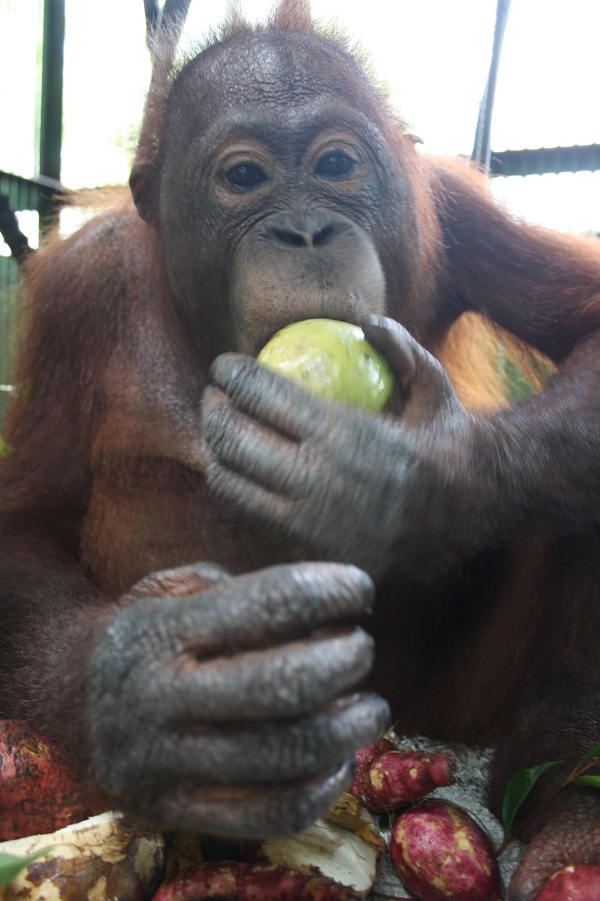
The orangutan’s name is Rocky and he is about one year old. He is extremely malnourished which, apart from his low body weight, is also indicated by his lack of hair, particularly on his head which is completely bald!

The infant is severely traumatised and requires constant encouragment to eat and drink. The medical team and the babysitters are caring for him around the clock to make him feel secure and build up his confidence. He  is currently being looked after in the baby quarantine area where he will be given plenty of time to recover in the weeks ahead before he is introduced to the other babies.
 
We’ll keep you posted on young Rocky’s progress ...

3 October 2012

Rescuing Laura


By volunteer Laurence from Hong Kong

25 September 2012 was a memorable day for me as a volunteer for IAR in Bogor, Indonesia. I was glad to be in the team for the rescue of a Javanese slow loris, Laura. I was really lucky to have an opportunity like this, particularly as I’m not able to stay here all that long!

In the morning of that day, I was told that there would be a rescue of a slow loris from a village near the primate rehabilitation centre here. It had been reported to IAR that someone in the village had a slow loris at their home and they would like to hand it over. We set off in the afternoon with a veterinarian, Dr Anne Dawydowa, and two IAR staff. All of us were excited to see the slow loris but, at the same time, also worried about the condition it would be in.

The location was just a small village. We wondered how they could have bought a slow loris from an animal market. Or even worse, had they captured it from the wild? I was curious to know where they had got this animal...

When we arrived, someone from the house took us to the slow loris. She had been put in a pet cage with a flattened cardboard box and some mango as food inside. She seemed scared to be exposed and was huddling in the corner. However, she still looked bright and not as bad as we had imagined. We had prepared a transport box with shade for the slow loris, so our vet tried to get Laura out of the pet cage and into our box as quickly as possible in order to reduce her stress. Slow lorises are nocturnal animals and they have a shy nature. Being exposed to sunlight and surrounded by people can be very stressful for them.

Unfortunately, some bloody stains were found on the cardboard box while our vet was handling the slow loris. We discovered that she was bleeding slightly from two wounds. One was between her index finger and thumb and another one was on her wrist. It was also noticed that some of her teeth were missing. This is very common among the slow lorises sold in the animal market and is done to prevent them biting the traders. Our vet put her quickly and carefully into our box, and some foliage as well, so that she would be more comfortable in a familiar environment. We covered the box well and then asked the owner some questions about Laura.


According to the owner, he had found the slow loris two weeks previously in a swimming pool and had brought it back home. It seemed he didn't even know what kind of animal it was as he looked surprised when he was told that it was a 'kukang' (slow loris in Indonesian.)

It was possible that he didn't intend to keep it as pet, but found he didn't know much about handling this 'kukang' after having taken it back home and so contacted IAR for help.

Our action was not only taking Laura but, more importantly, also educating the local people that wild animals should not be kept as pets. Their understanding could prevent similar stories happening again. So this was a real 'rescue operation’ for all slow lorises in Indonesia, not just Laura.

Laura is now in the care of our veterinary team and her wounds seem much better. We will keep on observing both her physical and behavioural status.  Hopefully one day she can be released back to where she belongs.

2 October 2012

Rickina and Jacky settle in well and Pelangsi continues to make good progress


By vet Silje Robertsen

Rickina has finished her quarantine and as the wound on her head has healed nicely she has been introduced to the other babies in the baby school group. They all are very fascinated by her scar from the machete wound and want to inspect it closely. Rickina herself is still a bit overwhelmed by all this attention, but seems to enjoy being the centre of the party and is getting braver every time we take her down. We are introducing her for short periods of time every day and hopefully soon she and Gunung will be climbing the ropes together!

Jacky has also been introduced to the baby school group and he seems to love the all new space and ropes to climb in. Although he stills whimpers a bit when there is no babysitter in sight, he is growing more independent every day and can play for hours on end with Karmila and Gunung and all the rest.

Pelangsi is in a good condition and is very active in his cage. Hopefully it won’t be long before he can return to the forest and show us all how well he can cope with his handicap. He is eagerly gathering leafs provided for him and making nests as well as he can, so he has definitely not forgotten his skills from the wild.


11 September 2012

Update on new arrivals Rickina, Roy and Johnny

By vet Silje Robertsen
 
Last Saturday we received two new animals that had been confiscated by the forestry department in Pontianak, the capital of West Kalimantan. We do not have much information about their captive living conditions, but they were not confiscated from the same owner though both are in good physical health.

Roy
Roy is a young male of about 3-4 years and unfortunately seems very habituated to humans indicating that he probably was taken from his mother at a very young age and has been living in captivity ever since.

Johnny is a few years older than Roy and a bit “rough around the edges”, but still very habituated to humans indicating the same early life fate as Roy. They are both placed in our quarantine cages and their group placement will be decided after the health screening and the quarantine period is successfully completed.

Johnny
Rickina, who was rescued a few weeks back and was suffering from a skin wound on the head, is showing good improvement. The wound is almost completely healed and she is a very active and independent young orangutan.

22 August 2012

Updates on all the orangutan antics in Ketapang


Baby orangutan Noel
By vet Silje Robertsen

At our orangutan rescue centre in Ketapang some of our younger orangutans have been introduced to new areas. Marsela, the young female who was rescued from a palm oil plantation in February this year was moved from the baby school to the larger play area for the juveniles and seems to be thoroughly enjoying the new space here.  Monti has also been moved to the larger play area and after an initial period of scepticism she is now playing enthusiastically and is settling in well with the “big guys”. 

Ujil was initially placed with the older babies in the back transit area, where he seemed to be settling in well. After some weeks though, it became clear that he was not coping too well in the new environment and he was showing signs of depression. The past month he has been together with the younger babies in the baby school area and here he seems to be more content. He is a gentle character, but knows how to defend himself in the not so seldom play fights with Jack or Bandut. He also keeps the baby sitters busy as he is continually looking for weak spots in our fencing and breaks out. 

Gunung and Noel are enjoying the status as the babies in the group. Especially Lady is thriving in the role of surrogate mother and loves pulling Gunung’s long hair. Also Rahayu and Oscarina will join in on the play: even when Noel and Gunung might be heading off in another direction they will firmly, but kindly, convince them to stay and play with them.

Pelangsi is showing a steady improvement as his wounds from the amputation operation have healed. It will surely be a long process for him to learn how to cope with his new disability, but he has already developed a technique for gathering leafs with his healthy arm and his mouth.

Rescued orangutan Jacky
On Saturday 18 August a young male orangutan was surrendered to our centre. He is called Jacky and is about one and a half years old.  He has probably been kept as a pet for most of his life as he is very attached to humans, but he has no signs of physical illness.  For now he is in our baby quarantine area awaiting the results of his health screening and if all is clear after the quarantine period he can join the other babies in the play area.

3 August 2012

Reducing stress in captive slow lorises

By Andy Gray 

Slow loris researcher Andy Gray
I am currently a volunteer researcher at IAR’s Ciapus Primate Centre studying to get my Master’s degree from Oxford Brookes University. In my 3 months here, I have been conducting a captive study to examine which types of enrichment might reduce stress for the slow lorises living here. In particular, I have used tree gums, as gouging large holes in trees for gum has been reported often in the wild. Because many of the lorises at the centre have their teeth brutally clipped or pulled in the illegal trade, gouging these holes is quite difficult for them in captivity. My goal was to provide a successful way for the lorises to eat tree gums while still performing some “gouging” behaviours through soft materials, like banana leaves. I also wanted this to be challenging and entertaining enrichment for the lorises with teeth as well.
It has been incredibly rewarding to watch the lorises enjoy the enrichment that the keepers, vets, and I designed. We have given them pine cones with mashed banana, branches with gum inside holes wrapped with banana leaf, and frozen gum and kalliandra flowers inside large bundles of grass (I suspect they liked this last one the most!). I have been very busy collecting as much data as I can for this study. The keepers joke that I have become a kukang (loris) because I collect data until 5am. It is incredible to be alone in the nighttime watching the lorises. I can’t say I’ve ever seen anything like it before. 
Erwin eating gum enrichment
Beyond my enrichment study, I have also conducted an experiment regarding boldness and shyness of the lorises. I have focused on lorises who are candidates for release, and have used novel objects to determine how willing they are to approach and explore new things. I hope that this will be beneficial for the centre when judging which lorises are the best candidates for release, because studies with other species have shown that animals survive better post-release if they are either bold or shy (depending on the species). No one has studied this before in lorises, so it is unknown whether or not they are more likely to survive if they are bold or shy. I am very excited for the long-term research possibilities for the centre, even after I leave. 
This project has been incredibly rewarding. It feels good to be contributing to both the captive care and the reintroduction project here at IAR Indonesia. However, the root of the problem is the illegal trade. In the future, I hope I can also be involved in efforts to combat this, as it is so important for the survival of the species and individual welfare. Please follow IAR Indonesia’s fantastic law enforcement work, and keep spreading the word about stopping the illegal wildlife trade!